
Video has been “the future of marketing” for so long that the phrase barely means anything anymore. Everyone posts videos and has a strategy deck. And yet, most teams still struggle to explain what their videos actually do beyond filling a content calendar.
The way people consume video has changed in ways you’ve probably already noticed. You don’t sit through every video anymore. You skim, stop midway, or close the tab because something else caught your attention.
A short clip might be enough to tell you whether a topic is important. A longer video only earns your time when you’re already trying to decide something.
So, when a video doesn’t perform, it’s rarely because the idea is bad. More often, it’s because the video pops up at a moment when the viewer isn’t ready for it yet.
That’s why a video marketing strategy in 2026 can’t be about formats alone. It has to account for intent, timing, and context. The same video can work brilliantly in one place and fail completely in another.
This guide is meant to help you think about video more practically. We’ll look at how video fits into workflows and what actually holds up when attention is limited, and expectations are higher.
How Video Consumption Will Change in 2026
In 2026, video is planned differently because it’s used differently. Most businesses are producing more video than before, largely because AI has reduced the effort required to plan, edit, and publish. That has pushed output up across the board. But it’s also made sameness easier to spot.
AI helps teams move faster, but it doesn’t automatically make video more effective. In many cases, it does the opposite by flattening tone and intent.
At the same time, short-form video continues to dominate reach. You use them to show relevance quickly. They don’t need to explain much. Their job is to tell the viewer whether this topic is worth another minute.
Because of this, video is being planned more carefully today. Teams are starting with one clear piece of content and then adapting it for different uses instead of producing separate videos for each platform.
Social platforms still drive discovery. But many of the videos that actually influence decisions are viewed elsewhere, like through emails, product pages, shared links, and internal tools. Those views don’t always show up as public engagement, but they’re often where clarity is built.
Short-Form vs Long-Form in 2026: What to Use and When
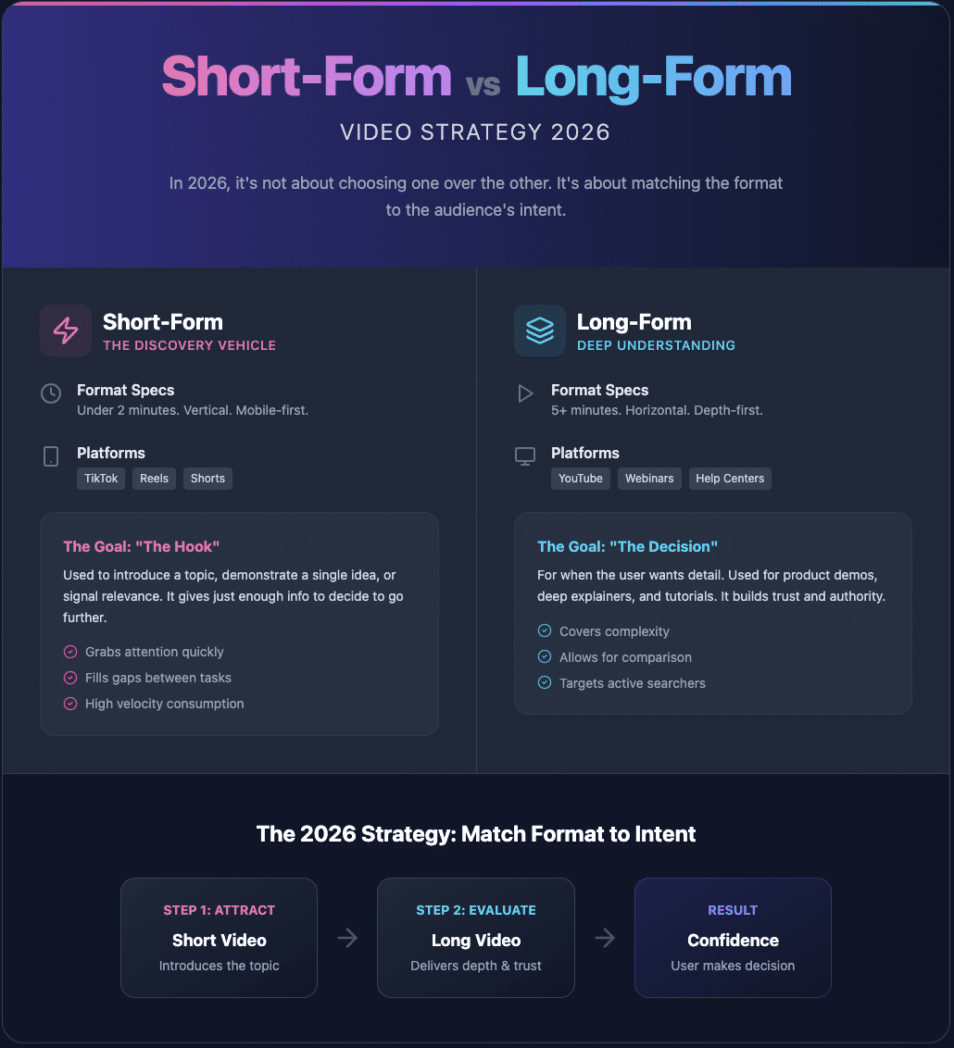
In 2026, short-form and long-form videos are still both part of a strategy, but they serve different purposes and are used at different points in the audience journey.
Short-Form Videos Are Still The Primary Discovery Vehicle
Short-form clips, typically under a couple of minutes, are the main format people see on social platforms. These are the videos that easily fit into feeds on TikTok, Instagram Reels, and YouTube Shorts, and users often watch them between other tasks, on mobile, in short bursts.
Short videos grab attention quickly and are often used to introduce a topic, demonstrate a single idea, or signal relevance. They’re less about explaining something in depth and more about giving someone just enough information to decide if they want to go further.
Long-Form Videos Are For Deeper Understanding And Decision-Making
Long-form content still plays an important role, especially when someone wants detail. Videos that run longer, such as product demos, tutorials, deep explainers, or recorded sessions, give space to cover complexity and build trust.
The purpose of longer videos hasn’t changed. They help people understand something fully, compare options, and feel confident in their decisions. In many cases, brands see these videos performing well in places where people actively search for answers, like YouTube or a help centre.
So, rather than choosing one format over the other, many teams are structuring video around use cases:
- Short video first to introduce and attract attention.
- Longer video later to deliver the depth someone needs when they are already interested or evaluating options.
This way, you match format to intent rather than trying to get every result from a single video.
AI’s Role in Video Marketing Strategy
AI’s role in video marketing is mostly operational. Teams are using it to speed up work that used to take time, like editing, captioning, trimming long recordings into short clips, and creating multiple versions of the same video for different platforms.
Most marketers already use AI in some part of their workflow, primarily to reduce manual effort rather than to generate ideas from scratch.
AI is also increasingly used after a video is published. Tools now analyse watch time, drop-off points, and engagement patterns to show where viewers lose interest.
Where AI does not help much is in decision-making. AI will save you time. It will help you spot patterns faster. What it won’t do is decide what a video should say, who it’s for, or when it should show up. Those calls still sit with you.
For video strategy, that’s the line to draw. Use AI to remove drag. Don’t expect it to replace intent.
Interactive Video Will Become Standard
Interactive video changes what you can do while watching. Instead of sitting through a full video, you can click, jump, or take an action when something becomes relevant. That’s the core difference between interactive and linear video.
This matters most when the viewer already has intent. Amazon’s ad data shows interactive video ads outperform standard formats across the funnel, including consideration and purchase intent, because the viewer can engage with specific elements instead of watching passively.
You see the same pattern in non-advertising contexts, too. Interactive formats are used more often in demos, training, and commerce because they let you focus on the part that matters to you and skip the rest.
Personalization at Scale in Video Marketing
Personalization in video doesn’t mean adding someone’s name to a thumbnail. It means changing what the video shows based on context.
When a video reflects where you are in the process, like your role, your industry, or what you’ve already looked at, it tends to perform better than a generic version.
Research on personalized video consistently shows higher engagement and response rates when content matches the viewer’s situation, especially beyond first touch.
So, this usually happens at the segment level, not the individual level. You create versions of the same video for different use cases. For global audiences, teams can also adapt these versions with an AI dubbing tool, making the same content accessible in different languages without recreating each version from scratch. That’s how personalization scales without turning into manual work.
This matters most after discovery. Early videos can stay broad. But once someone is comparing options or trying to understand details, generic messaging starts to feel thin. At that point, showing the right example or framing the problem in familiar terms makes the video easier to engage with.
Video in the B2B Buyer Journey in 2026
Most buyers today don’t move in a straight line. They read, pause, compare, loop back, and check with others. Video fits into that messier process as a way to reduce uncertainty.
Early in the journey, video tends to stay high-level. Short explainers, overviews, or use-case clips help you decide whether a problem is worth thinking about at all. These videos aren’t meant to convince you, instead they’re meant to help you orient yourself.
Later on, video becomes more concrete. Product demos, walkthroughs, recorded sessions, and customer examples are used to answer specific questions. This is the stage where buyers spend time rewatching parts of a video, sharing it internally, or coming back to it before a decision.
What’s important here is placement. Videos that influence B2B decisions are rarely watched in feeds. They’re opened from emails, product pages, shared links, or internal tools. Google’s B2B research consistently shows that buyers use video alongside other content formats as part of their own research.
For strategy, this changes how you plan video. Instead of thinking in terms of top-funnel or bottom-funnel assets, it’s more useful to think in terms of questions like how does this video help answer, or at what point would someone actually be asking it.
So, if you create videos around that logic, it fits naturally into the B2B buyer journey instead of trying to force momentum.
Bonus Read: How Startups Scale Video Content Creation with AI-Powered Screen Recordings
Video Distribution Strategy for 2026
People watch marketing videos in a lot of places. YouTube, TikTok, Instagram, LinkedIn, emails, product pages, courses, help centres, and internal tools all play a role.
Social platforms still drive the most discovery. YouTube, TikTok, and Instagram are where most people first see video content, especially on mobile. That means if awareness or initial relevance is your goal, distribution starts with social supported by tools like an Instagram Hashtag Generator to boost reach and visibility.
Email and owned channels become important when context already exists. Putting video in newsletters, inside a product page, or in a course module means the viewer has already decided to engage.
Those placements don’t always generate public views, but they influence decisions more directly because the viewer found the video where they needed it.
How you schedule and reuse your videos also matters. A long video can become multiple short clips with different distribution goals like feed reach, in-product support, and email follow-ups.
Finally, tracking performance matters more than ever. It’s not enough to post and forget. A good distribution strategy uses data about watch time, engagement, click-through, and conversion to decide where to put the next video or what to change next.
Metrics That Will Matter in 2026
Watch time is still one of the clearest signals. Not the total duration, but how long people stay and watch your video before dropping off.
Platforms like YouTube and LinkedIn already prioritise videos that retain viewers longer because retention correlates more strongly with relevance than raw views.
Engagement quality also matters more than engagement volume. Saves, replays, clicks, and shares carry more weight than likes because they signal intent. Most platforms now surface and rank content based on these deeper actions rather than surface-level reactions.
For videos used beyond discovery, downstream metrics matter the most. Clickthroughs from a product page, demo requests after watching, or repeated internal views are better indicators of impact than public performance.
Tools and Tech Stack for a 2026-Ready Video Strategy
A usable video stack usually has four parts.
- Recording: To capture meetings, demos, walkthroughs, and explainers without setup overhead.
- Editing and Repurposing: For basic video edits like trimming, clipping, and format changes that need to be fast.
- Search and Reuse: For transcripts, chapters, and summaries. If you can’t search past videos or quickly pull a specific section, the content loses value after the first watch.
- Distribution and Measurement: Videos need to be easy to share across email, product pages, courses, and internal tools, with visibility into where they’re actually watched and what happens next.
How Dadan Fits Into a 2026 Video Content Marketing Strategy
In a 2026 video strategy, recording is rarely the hard part. The problem usually is everything that comes after.
Teams record product demos, sales calls, training sessions, or internal walkthroughs. Those recordings contain useful explanations, objections, and decisions, but they’re locked inside long videos. If you weren’t on the call, finding one specific moment later is difficult.
Dadan fits into this gap by making recorded video usable beyond the first watch. Instead of rewatching a full call, you can jump straight to the part where a feature was explained or a question came up. This also changes how you reuse video. A single demo or walkthrough can be broken into smaller clips based on the content.
Dadan is most useful when video is part of day-to-day work. Sales, customer success, education, and internal teams benefit because recordings stop being disposable. They become references people can return to for clarity.
Common Mistakes to Avoid in 2026
- Making videos without knowing where they’ll be used or what question they’re meant to answer.
- Posting the same video everywhere without adjusting length, context, or placement.
- Over-producing videos that are meant to test ideas, explain workflows, or support decisions.
- Recording long videos once and never breaking them into smaller, usable pieces.
- Measuring success only through views or likes instead of retention, clicks, or follow-up actions.
- Letting AI tools decide what to publish instead of using them to speed up work you’ve already thought through.
- Assuming video lives only on social feeds and ignoring email, product pages, courses, and internal documentation.
Step-by-Step Framework to Build Your 2026 Video Strategy
- Start with the question, instead of the format. Write down what someone should understand or decide after watching the video.
- Decide where the video will be published before you record it (feed, email, product page, course, or internal doc).
- Record one complete asset first.
- Make the video easy to navigate later with transcripts, chapters, or timestamps.
- Pull smaller clips from the original recording only when they serve a specific use.
- Use interaction or personalization only when the viewer already has context and intent.
- Distribute based on intent.
- Measure what the video actually helped with.
- Reuse what works. Change what doesn’t.
Conclusion
Video works when it shows up at the right moment, answers a real question, and fits naturally into how people already work, learn, or decide. Short videos help someone notice you. Longer videos help them understand you.
Knowing why a video exists, where it will be used, and what it should help someone do next is all that matters. When that thinking is in place, tools, platforms, and AI become useful.
If you plan video as part of a system, you end up with better videos, better outcomes, and less wasted effort. That’s the shift that matters going into 2026.
FAQs
What is video content marketing, and why is it important in 2026?
Video content marketing uses video to explain, demonstrate, or support decisions. In 2026, it’s important because people rely on video to understand details before they act, not only to discover ideas.
How is video marketing changing in 2026 compared to previous years?
Video is no longer only for reach. It’s used alongside pages, emails, and documentation to help people evaluate and decide.
What types of video content will perform best in 2026?
Videos that answer specific questions perform better than broad brand storytelling.
What is the 70 20 10 rule in content?
It’s a planning rule. 70% proven content, 20% improvements, 10% experiments. For video, it helps balance reliability with testing new formats.
How can video be used for lead generation and conversions?
Video helps by reducing uncertainty. A clear explanation or demo often supports the step right before someone takes action.